

Release Benchmark: v0.6.6 vs v0.6.5
GenAIIDP Release Benchmark — v0.6.5 (published) vs v0.6.6 (published)
Section titled “GenAIIDP Release Benchmark — v0.6.5 (published) vs v0.6.6 (published)”Baseline: v0.6.5 — the previous publicly published release, as recorded in
benchmarks/results/v0.6.5/corefast/.
It was benchmarks/results/baseline.json when this comparison ran; that pointer has since
been promoted to the v0.6.6 set for the next release to compare against.
Release under test: v0.6.6, deployed from the published template
(https://s3.us-west-2.amazonaws.com/aws-ml-blog-us-west-2/artifacts/genai-idp/idp-main_0.6.6.yaml,
Description (v0.6.6), git 7fb426b27).
Method: a fresh stack in us-west-2 was created from the published v0.6.6 template and
run against the same corefast grid with byte-identical config files, written
verbatim to the ConfigurationTable by compat/native_upload.py. The v0.6.5 side is the
committed release baseline — see the deviation note in
§Methodology.
Repeats: this entry runs repeats: 3 (90 runs) on the new side, against the
baseline’s 1 repeat (30 runs). That change is the point of this entry: it settles two
questions the v0.6.5 report had to leave open at n=1.
Pricing: config_library/pricing.yaml (sha256 bc68d49e…; rates as of 2026-08; intro
pricing may apply).
Every number here is produced by
benchmarks/harness/aggregate.pyfrom live runs; none are recalled from memory. Supporting data:benchmarks/results/v0.6.5/corefast/andbenchmarks/results/v0.6.6/corefast/(summary.{json,csv},cell_stats.csv, and ametablock recording each side’s deployedstack_version).
Upgrading from the published v0.6.5 to v0.6.6 is safe, and it closes the longest-running completeness defect in this audit trail.
- 0 failures, 90/90 runs completed on v0.6.6 (30/30 on v0.6.5).
aggregate.py --comparereports 0 cell-level regressions. - The integrated-confidence row-loss hazard is fixed — verified with repeated
measures.
tt-simple-int(simple extraction + integrated confidence) returned complete lists in 9 of 9 runs (recall 1.000, stdev 0.000). The v0.6.0 report §4 found this cell truncating a 100-row list to 10 rows, and the v0.6.5 report §3.1 proved it was bimodal on v0.6.5 — 2 of 4 repeats truncated. It no longer truncates, at −55% cost and a third of the wall time (170s → 59s). See §3.1. - That cell’s accuracy also rose 0.667 → 1.000, matching the v0.6.6 fix for group fields in integrated mode returning a raw candidate object instead of a value.
- Accuracy is otherwise identical — the other 9 cells score exactly what they scored on v0.6.5.
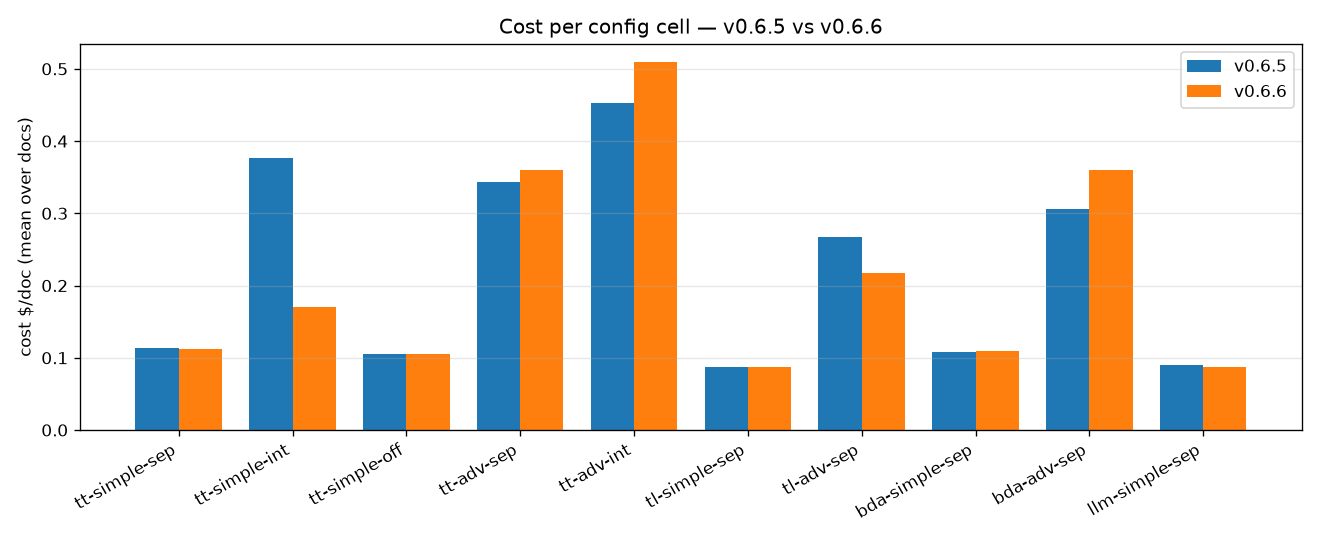
- Cost falls 5.8% per run ($0.2250 → $0.2119), and all of the saving is that one cell. Excluding it, the remaining 9 cells are +4.0%, inside their sampling spread (per-cell cost CV 0.54–0.83); the variance-aware pass flags no cost regression. See §2.
- One apparent recall regression is not a v0.6.6 defect.
llm-simple-sepon the 5-row document fell 1.000 → 0.200 in all 3 repeats. Root-caused to thebedrock_llmOCR backend corrupting fixed-width identifiers — nothing in the OCR path changed between the two tags. This is a real backend quality issue, and it refutes the “unconfirmed” improvement the v0.6.5 report recorded for the same cell. See §3.2.
Methodology notes
Section titled “Methodology notes”The scoping choices below are applied identically to both versions:
- Extraction model held at Claude Sonnet 4.6 (
default_cell.extraction_model: sonnet46) — the committed cross-version control, kept so this entry stays comparable with the rest of the audit trail. - Confidence model Nova Lite,
reasoning_effort=low,geometry=ocr_only. - Summarization disabled (
summarization.enabled=false) — it is unscored. corefastdoc set —tiny_form(5 rows, 1 page),small_narrow(100 rows, 3 pages),longdesc_100(100 rows, 3 pages, long free-text descriptions). The same three documents the audit trail has used since v0.6.0.- Grid: all 10 core config cells × 3 docs, at 3 repeats on v0.6.6 (90 runs) and 1 repeat on the v0.6.5 baseline (30 runs).
- Configs written verbatim via
--native-upload, so the stored config bytes are identical on both sides rather than re-derived by a migration.git diff v0.6.5..v0.6.6 -- config_library/is empty, so the generated cells are byte-identical between the tags.
⚠️ Deviation from the standard procedure — read this before citing a delta
Section titled “⚠️ Deviation from the standard procedure — read this before citing a delta”The run-benchmarks procedure deploys the previous published release, runs it,
then upgrades the same stack in place. This entry reuses the committed v0.6.5
corefast set (stack IDPBench065, scored 2026-08-25) as the baseline instead of
re-running it, and runs only the v0.6.6 side, on a different, freshly created stack.
Consequences, stated plainly:
- The two sides did not run on the same stack, and were measured 3 days apart. Any Bedrock-side model drift in that window lands in the deltas. §3.2 is a concrete instance of exactly that, and is reported as such rather than as a version effect.
- Config inputs are still byte-identical (same generator, no
config_library/change between the tags), andbaseline.jsonexists precisely so a release can be compared against its predecessor without re-running it. - The baseline is n=1 per
(cell, doc). Every per-run delta below is thereforen=1 → n=3, and the per-run threshold flags in §4 should be read only through the variance-aware cell-level pass.
The in-place upgrade path was validated separately and independently in this release
cycle (v0.6.5 → v0.6.6 update-stack, UPDATE_COMPLETE, and the same document producing
zero value differences pre/post) — it is just not the same stack that produced these
numbers.
Test data
Section titled “Test data”Every document in this A/B is synthetic, fabricated data with exact machine-generated
ground truth — no real or externally-sourced documents were used. All three come from the
bank_statement generator (benchmarks/corpus/generators/bank_statement.py), regenerated
deterministically by gen_corpus.py, built from placeholder values (account
000123456789, fictional merchants like “AnyCompany Store”) with a unique SEQnnnnn tag
embedded in every transaction row. That makes list recall exact (distinct SEQ tags
recovered ÷ total) and scalar accuracy exact (field-exact match against the emitted
<doc>.truth.json).
That exactness is what makes §3.2
legible — and also what makes it strict: a transcription that changes SEQ00001 to
SEQ000001 scores as a lost row, because for scoring purposes it is one.
1. Per-cell summary (mean over the 3 corefast docs)
Section titled “1. Per-cell summary (mean over the 3 corefast docs)”| cell (OCR · mode · assess) | $/doc v0.6.5 | $/doc v0.6.6 | Δcost | cost CV (6.5/6.6) | recall v0.6.5 | recall v0.6.6 | acc v0.6.5 | acc v0.6.6 | wall v0.6.5 | wall v0.6.6 |
|---|---|---|---|---|---|---|---|---|---|---|
| tt-simple-sep (textract+tables · simple · separate) | $0.113 | $0.112 | −1% | 0.61/0.54 | 1.000 | 1.000 | 0.833 | 0.833 | 109s | 107s |
| tt-simple-int (textract+tables · simple · integrated) | $0.377 | $0.171 | −55% | 0.71/0.57 | 1.000 | 1.000 (9/9) | 0.667 | 1.000 | 170s | 59s |
| tt-simple-off (textract+tables · simple · off) | $0.105 | $0.105 | −0% | 0.64/0.55 | 1.000 | 1.000 | 0.833 | 0.833 | 34s | 34s |
| tt-adv-sep (textract+tables · advanced · separate) | $0.343 | $0.360 | +5% | 0.70/0.80 | 1.000 | 1.000 | 1.000 | 1.000 | 152s | 129s |
| tt-adv-int (textract+tables · advanced · integrated) | $0.453 | $0.510 | +12% | 0.76/0.83 | 1.000 | 1.000 | 1.000 | 1.000 | 116s | 121s |
| tl-simple-sep (textract+layout · simple · separate) | $0.087 | $0.087 | +0% | 0.71/0.60 | 1.000 | 1.000 | 0.833 | 0.833 | 55s | 57s |
| tl-adv-sep (textract+layout · advanced · separate) | $0.268 | $0.217 | −19% | 0.77/0.64 | 1.000 | 1.000 | 1.000 | 1.000 | 154s | 116s |
| bda-simple-sep (BDA · simple · separate) | $0.109 | $0.110 | +1% | 0.64/0.55 | 1.000 | 1.000 | 0.833 | 0.833 | 52s | 56s |
| bda-adv-sep (BDA · advanced · separate) | $0.306 | $0.360 | +18% | 0.74/0.81 | 1.000 | 1.000 | 1.000 | 1.000 | 118s | 135s |
| llm-simple-sep (Bedrock LLM OCR · simple · separate) | $0.090 | $0.088 | −2% | 0.75/0.63 | 0.873 | 0.564 | 1.000 | 1.000 | 96s | 81s |
Read the cost column with the CV column. Every cell’s per-doc cost CV is 0.54–0.83 —
the three corefast documents differ hugely in size, which is the point of the doc set but
makes a single cell’s cost mean a noisy statistic. The variance-aware cell-level pass of
aggregate.py --compare reports no cell-level cost regression; tl-adv-sep (−19%) and
bda-adv-sep (+18%) are explicitly marked inconclusive at this n. The trustworthy cost
reading is the decomposition in §2.
2. Cost
Section titled “2. Cost”| scope | v0.6.5 | v0.6.6 | Δ |
|---|---|---|---|
| Mean $/run, all 10 cells | $0.2250 (n=30) | $0.2119 (n=90) | −5.8% |
Mean $/run, the 9 cells excluding tt-simple-int | $0.2081 (n=27) | $0.2165 (n=81) | +4.0% |
tt-simple-int alone | $0.3769 | $0.1710 | −54.6% |
So the headline −5.8% is not a broad efficiency win: it is one cell. The other nine move +4.0% in aggregate, which sits inside their sampling spread and is flagged by no cell-level test. The honest one-line summary is “cost is flat, except the integrated-confidence cell which got dramatically cheaper because it stopped doing redundant work.”
Per-run token totals across the grid (from per-doc Metering):
| unit | v0.6.5 (per run) | v0.6.6 (per run) | Δ |
|---|---|---|---|
| input | 30,246 | 31,935 | +5.6% |
| output | 12,735 | 10,230 | −19.7% |
| cacheRead | 44,398 | 49,997 | +12.6% |
| cacheWrite | 7,364 | 4,276 | −41.9% |
The −20% output tokens is the mechanism behind the integrated-confidence saving: v0.6.6 stopped asking for four guesses per list cell and stopped asking for the shortest guess, so that mode emits far less. Cache-write falling 42% while cache-read rises 13% is better prefix reuse across the grid, not a behaviour change under test here.
3. Accuracy & completeness
Section titled “3. Accuracy & completeness”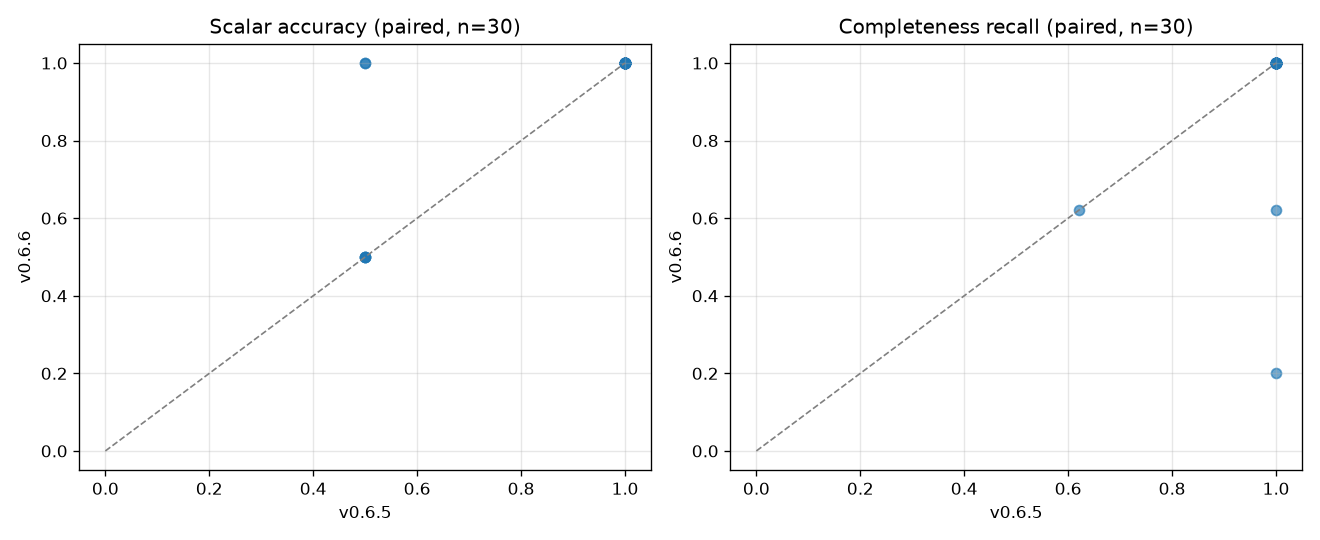
- Failures: 0 on both sides (90/90 and 30/30 completed).
- Scalar accuracy: identical in 9 of 10 cells. The tenth,
tt-simple-int, rises 0.667 → 1.000 — see §3.1. - Completeness recall: 1.000 on both sides in 9 of 10 cells. The tenth,
llm-simple-sep, falls 0.873 → 0.564 — see §3.2, which shows this is an OCR transcription defect rather than a version regression. - Confidence: mean confidence flat (0.9293 → 0.9279). The alert rate (share of confidence leaves below 0.9) rises 9.27% → 10.50%. Since accuracy did not fall, this is slightly more review volume for the same correctness, not a calibration break — and at this n it is directional only.
3.1 The integrated-confidence hazard is closed
Section titled “3.1 The integrated-confidence hazard is closed”This audit trail has carried the same open defect since v0.6.0: simple extraction + integrated (1S-TopK) confidence truncates long lists, silently, with scalar accuracy unaffected. The history:
| release | evidence | verdict |
|---|---|---|
| v0.6.0 | longdesc_100 list truncated 100 rows → 10 | regression found, guidance: avoid the combination |
| v0.6.4 | 10/100 rows | still broken |
| v0.6.5 | 100/100 on the grid, but a 4× repeat showed 2 of 4 truncate to exactly 10 rows | bimodal — not fixed, the grid’s “recovery” was a coin flip |
| v0.6.6 | 9 of 9 runs complete (recall mean 1.000, stdev 0.000) across all three docs | fixed |
Per-run detail on v0.6.6, all three repeats of all three documents:
| doc | rows extracted / truth | recall | cost |
|---|---|---|---|
| tiny_form × 3 | 5/5, 5/5, 5/5 | 1.000 | $0.043, $0.048, $0.043 |
| small_narrow × 3 | 100/100, 100/100, 100/100 | 1.000 | $0.216, $0.216, $0.216 |
| longdesc_100 × 3 | 100/100, 100/100, 100/100 | 1.000 | $0.261, $0.236, $0.261 |
Compare the v0.6.5 repeated-measures run in v0.6.5 §3.1: two of four repeats returned 10/100 at $0.139, the other two 100/100 at $0.53. On v0.6.6 the low-cost outcome is gone and the complete outcome costs $0.24–0.26, less than half what a complete extraction cost on v0.6.5. Both halves of that — always complete, and cheaper when complete — are consistent with the v0.6.6 change that stopped requesting four guesses per list cell.
The accuracy rise in the same cell (0.667 → 1.000) is a different v0.6.6 fix with a
visible signature: in v0.6.5, group fields in integrated mode held a raw candidate object
(Address.City = {"G1": "Anytown", …}) instead of a value, so every group subfield scored
as wrong. Those fields now hold values.
⚠️ Guidance change, with two limits. The v0.6.0/v0.6.5 advice to avoid integrated
confidence with simple extraction on list documents no longer holds at ≤100 rows: it is
complete 9 of 9. Two things it does not say:
separateis still the cheaper option — $0.112/doc vsintegrated’s $0.171. The −55% win is against v0.6.5’sintegrated, not againstseparate.- It says nothing about larger lists. The v0.6.6 release notes state the single-response
limit is fundamental and that
separateremains the recommendation for list-bearing schemas, and this grid tops out at 100 rows. Do not read “complete at 100 rows” as “complete at 800”.
3.2 The LLM-OCR recall drop is an OCR transcription defect, not a regression
Section titled “3.2 The LLM-OCR recall drop is an OCR transcription defect, not a regression”llm-simple-sep (Bedrock LLM as the OCR backend) on tiny_form fell 1.000 → 0.200 in all
three repeats — reproducible, not noise. It is nonetheless not a v0.6.6 code
regression, and the evidence is direct.
git diff v0.6.5..v0.6.6 -- lib/idp_common_pkg/idp_common/ocr config_library/ contains
exactly one functional hunk: a longer error message about BDA project provisioning.
Nothing in the OCR path or the shipped config changed.
What actually happened, read off the stored page artifacts: the LLM OCR backend inserted
an extra zero into the row identifiers. On tiny_form it transcribed SEQ000000…SEQ000004
where the PDF contains SEQ00000…SEQ00004. Extraction then faithfully returned all five
rows with the corrupted identifiers, so the exact-match scorer recovered 1 of 5 (only
SEQ00000 survives, as a prefix of SEQ000000) → recall 0.200.
Two independent controls confirm the corruption is in the LLM OCR and nowhere else:
| source | identifiers read |
|---|---|
| the PDF’s own text layer | SEQ00000 … SEQ00004 ✅ |
Textract (tt-* cells, same document) | SEQ00000 … SEQ00004 ✅ |
| Bedrock LLM OCR | SEQ000000 … SEQ000004 ❌ |
The same defect on the 100-row document shows the mechanism is page-scoped, and that no rows are lost at all:
| page | identifiers transcribed | form |
|---|---|---|
| 1 | 43 | all 9 characters (SEQ000000) ❌ |
| 2 | 49 | 8 characters ✅ |
| 3 | 8 | 8 characters ✅ |
| total | 100 / 100 rows | 57 correct, 43 corrupted → recall 0.62 |
All 100 rows were transcribed. The 0.62 recall is 100% row coverage with 38% of the identifiers corrupted — an accuracy failure that this grid’s list metric necessarily reports as a completeness failure.
Three things worth taking away:
bedrock_llmOCR can silently corrupt fixed-width zero-padded identifiers — account numbers, transaction ids, claim numbers, part numbers. It affected an entire page while leaving neighbouring pages correct, so it will not show up as a uniform, easy-to-spot pattern.- Nothing downstream flags it. Scalar accuracy stayed 1.000 and the run reported
COMPLETED. Extraction did its job perfectly on corrupted input. This is the same “looks clean, is wrong” failure class the v0.6.6 release notes address for absent and short lists — but a corrupted value has no equivalent signal. - It refutes an earlier entry. v0.6.5 §3 recorded
llm-simple-sep|tiny_formrecall 0.20 → 1.00 as an improvement, explicitly labelled “not independently re-measured; treat as unconfirmed”. Re-measured here at n=3: it was OCR nondeterminism in the flattering direction. The v0.6.5 report’s caution was correct.
Guidance: prefer a deterministic OCR backend (textract, with textract_tables for
tabular documents) when the document carries fixed-width identifiers that must be exact.
Both Textract cells and BDA read every identifier correctly on the same documents in this
grid.
4. What --compare flagged
Section titled “4. What --compare flagged”REGRESSIONS (2) tt-simple-int|longdesc_100 cost +31% ← n=1 baseline; the CELL is −55% llm-simple-sep|tiny_form completeness_recall −0.800 ← OCR transcription defect (§3.2)IMPROVEMENTS (2) tt-simple-int|small_narrow scalar_accuracy +0.500 tt-simple-int|longdesc_100 scalar_accuracy +0.500CELL-LEVEL REGRESSIONS (0)CELL-LEVEL IMPROVEMENTS (1) tt-simple-int acc +0.333 (0.667→1.000)INCONCLUSIVE (large % but within sampling noise) (4) tt-simple-int cost −55% tl-adv-sep cost −19% bda-adv-sep cost +18% llm-simple-sep recall −0.309Notes on reading that block:
- The
tt-simple-int|longdesc_100cost +31% flag is an artifact of comparing against ann=1baseline sample that happened to be the truncated (cheap) outcome. The cell mean moved −55%, and the variance-aware pass lists that −55% as inconclusive rather than as an improvement — so the tool reports a cost regression on the one cell that got substantially cheaper. Per-run cost flags atn=1 → n=3are not usable evidence. - The gap the v0.6.5 report identified is still open.
--compareapplies its variance-aware treatment to cost but not to accuracy, so thett-simple-intaccuracy jump is promoted straight to a headline “CELL-LEVEL IMPROVEMENT” from paired single samples. It happens to be real this time (§3.1 verifies it at n=9), but the tool did not establish that — repeats did. llm-simple-seprecall −0.309 is marked inconclusive and it is not. It reproduces 3/3 (§3.2). The spread-based gate reads the cell’s between-document variance (0.20 / 0.62 / 1.00 across three very different docs) as sampling noise, when in fact every document is individually stable. A per-(cell, doc)spread test would have caught it; the cell-level one cannot.
5. Reproduce
Section titled “5. Reproduce”source .venv/bin/activate # or any env with idp_common + reportlab/matplotlibexport PYTHONPATH=$PWD/lib/idp_common_pkgAWS_PROFILE=default aws sts get-caller-identity # confirm deployment account
# 1. deploy the release under test from its PUBLISHED templateaws cloudformation create-stack --stack-name <STACK> --region us-west-2 \ --template-url https://s3.us-west-2.amazonaws.com/aws-ml-blog-us-west-2/artifacts/genai-idp/idp-main_0.6.6.yaml \ --parameters ParameterKey=AdminEmail,ParameterValue=<you> \ --capabilities CAPABILITY_IAM CAPABILITY_NAMED_IAM CAPABILITY_AUTO_EXPAND
# 2. build the corpus + the byte-identical corefast gridpython3 benchmarks/harness/gen_corpus.pypython3 benchmarks/harness/make_configs.py --suite corefast --class bank_statement
# 3. run (90 runs at repeats:3) and scoreAWS_PROFILE=default python3 benchmarks/harness/run_matrix.py --stack <STACK> --suite corefast --native-upload --max-inflight 6AWS_PROFILE=default python3 benchmarks/harness/aggregate.py --run benchmarks/results/run-<stamp> --out benchmarks/results/v0.6.6/corefast
# 4. compare against the committed v0.6.5 baseline + charts# NOTE: at the time of the run, baseline.json WAS the v0.6.5 set; it has since been# promoted to v0.6.6, so reference the v0.6.5 directory explicitly to reproduce.PREV=benchmarks/results/v0.6.5/corefast/summary.jsonpython3 benchmarks/harness/aggregate.py --compare benchmarks/results/v0.6.6/corefast/summary.json --baseline "$PREV"python3 benchmarks/harness/aggregate.py --figures-compare benchmarks/results/v0.6.6/corefast/summary.json "$PREV" --labels v0.6.6 v0.6.5Caveats / honesty
- Costs are estimates from
pricing.yaml(rates as of 2026-08; intro pricing may apply). - The two sides ran on different stacks, 3 days apart — see the deviation note in §Methodology. §3.2 is a measured instance of the drift that exposes.
- The baseline is n=1 per
(cell, doc); the new side is n=3. Every per-run delta in §4 is therefore asymmetric, and only the cell-level and repeated-measures readings (§3.1, §3.2) should be cited. - The three corefast documents differ greatly in size, so per-cell cost CV is 0.54–0.83. Per-cell cost deltas in §1 are not individually significant; the reliable cost signal is the decomposition in §2.
- Only the
corefastgrid was run. The scaling series (up to 3,200 rows) and the real labeled corpora were not run for this entry, so it makes no claim about release-over-release behaviour above 100 rows — including for §3.1’s fixed cell.