

Release Benchmark: v0.6.0 vs v0.5.16
GenAIIDP Release Benchmark — v0.5.16 (published) vs v0.6.0 (develop)
Section titled “GenAIIDP Release Benchmark — v0.5.16 (published) vs v0.6.0 (develop)”Baseline: v0.5.16 — the latest publicly published release
(s3://aws-ml-blog-us-west-2/artifacts/genai-idp/idp-main.yaml, Description
(v0.5.16)).
Release under test: v0.6.0.dev18 (develop @ commit 4c063b647).
Method: a single stack (IDPbench0516, us-west-2) was
created from the published v0.5.16 template, benchmarked, then upgraded in place
to v0.6.0 via idp-cli deploy --from-code . --clean-build and benchmarked again with
byte-for-byte identical config files. The only variable between the two runs is
the accelerator code version.
Pricing: config_library/pricing.yaml (sha256 c7675fb7…; rates as of 2026-07;
intro pricing may apply).
Every number here is produced by
benchmarks/harness/aggregate.pyfrom live runs; none are recalled from memory. Supporting data:benchmarks/results/v0.5.16/corefast/andbenchmarks/results/v0.6.0/corefast/(summary.{json,csv},cell_stats.csv,meta.json).
Upgrading from the published v0.5.16 to v0.6.0 is safe and cheaper:
- Accuracy is identical. Mean scalar-field accuracy is 0.917 on both versions; completeness recall is identical (0.956 → 0.956) once the single integrated-mode outlier below is excluded.
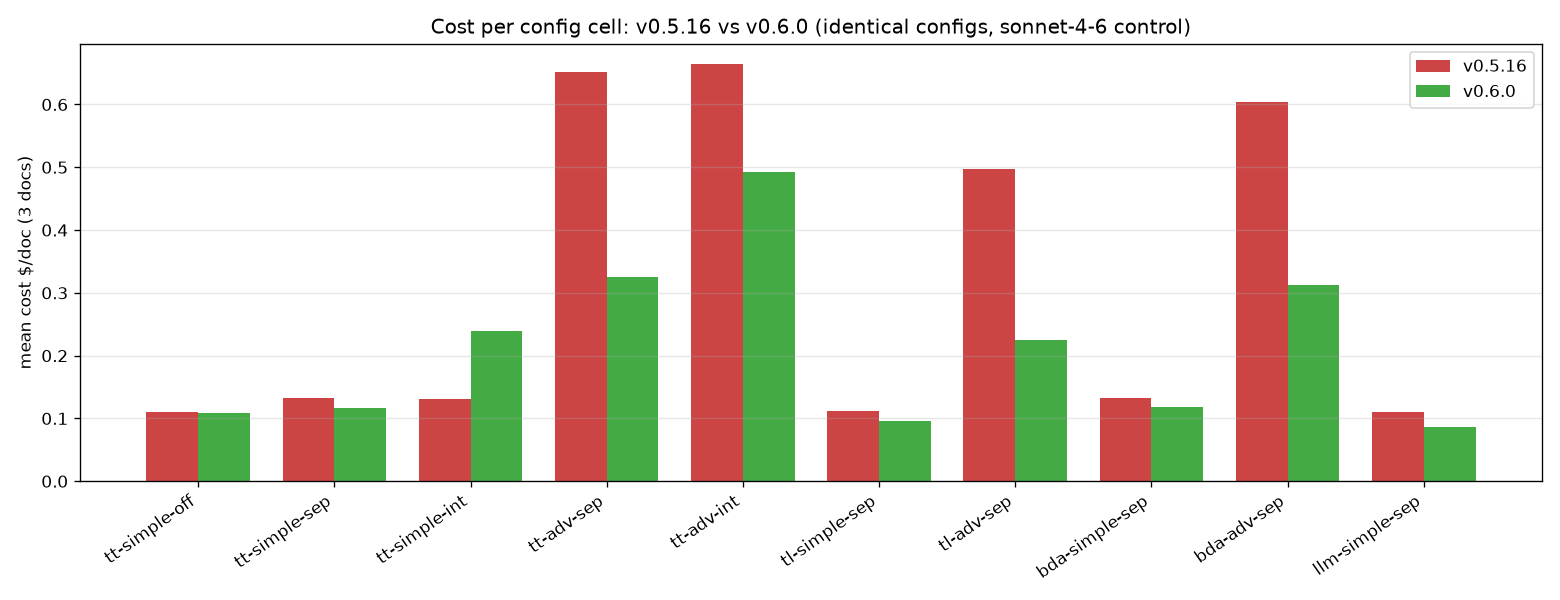
- Cost drops ~⅓. Across the 30-run grid, total cost fell −32.5% ($9.43 → $6.37). The win concentrates in the advanced (agentic) and BDA cells: −44% to −55%. Driven by a 20× reduction in cache-read tokens (23.7M → 1.17M) — v0.6’s prompt-cache / agentic-tool-writeback fixes (#457) and lazy-image loading.
- One regression to know about: simple + integrated confidence
(
tt-simple-int) under-extracts long-description list documents on v0.6 — recall 1.00 → 0.10 onlongdesc_100(100-row doc) — because v0.6’s single-pass integrated extraction+confidence truncated the list. Integrated confidence is a niche mode; separate and off are unaffected. See §4. - Latency is flat-to-better on v0.6 (advanced cells finish ~30–40% faster).
Methodology notes (why these exact configs)
Section titled “Methodology notes (why these exact configs)”Running the v0.6-native benchmarks/ suite against a v0.5.16 stack surfaced five
genuine cross-version incompatibilities. All were resolved in the harness so the
same config bytes run on both versions, isolating the code-version variable:
| # | Issue | Fix |
|---|---|---|
| 1 | idp-cli finds the TestRunner only in the main stack; on v0.5.16 it lives in the nested APPSYNCSTACK (v0.6: APIRESOLVERSTACK). | run_matrix.launch() invokes the TestRunner Lambda directly (substring match over all functions). |
| 2 | v0.5.16 cannot run Claude Sonnet 5 — its Bedrock client only strips the (now-deprecated) temperature param for opus-4-7/4-8, so Sonnet 5 → ValidationException. | Held the extraction model at claude-sonnet-4-6 as the shared control (runs on both). “v0.6 unlocks Sonnet 5” is a capability delta, out of scope for this A/B. |
| 3 | v0.6 sources assessment prompts from system defaults at runtime; v0.5.16 reads a top-level assessment.task_prompt from the stored config. | Configs are fully merged with system defaults and a top-level assessment block is re-injected. v0.6 ignores it (extra="ignore"); v0.5.16 uses it. |
| 4 | idp-cli config-upload always runs migrate_v05_to_v06, which drops the top-level assessment block. | compat/native_upload.py writes the config verbatim (gzip Binary, _config_format=full) to the ConfigurationTable, bypassing migration. Used for both stacks → identical stored bytes. |
| 5 | v0.6 stores empty/0 max_tokens/shard_token_budget (“use model default”); v0.5.16 enforces gt=0 and rejects the whole config. | sanitize_for_v0516() fills non-positive values with each version’s own defaults. |
Two deliberate scoping choices, applied identically to both versions:
- Summarization disabled (
summarization.enabled=false): it is unscored, and its default model (Sonnet 5) hits issue #2 on v0.5.16. corefastdoc set (tiny_form5-row,small_narrow100-row,longdesc_100100-row long-description). Advanced/agentic mode + granular assessment on ≥400-row documents times out the 900 s assessment Lambda on v0.5.16, and Step Functions then retries up to 8× (2.5× backoff) → ~2 h/doc before failing. A full 10-cell grid that completes on both versions therefore requires ≤100-row docs. This is itself a finding (§5).
Grid: all 10 core config cells × 3 docs = 30 runs per version; both versions
completed 30/30 with 0 failures. Extraction = Sonnet 4.6, confidence model = Nova
Lite, reasoning_effort=low, geometry = ocr_only.
Test data
Section titled “Test data”Every document in this A/B is synthetic, fabricated data with exact machine-generated
ground truth — no real or externally-sourced documents were used. The three docs are
the corefast set (tiny_form, small_narrow, longdesc_100), all produced by the
bank_statement generator in benchmarks/corpus/generators/bank_statement.py and
regenerated deterministically by gen_corpus.py. Each is a bank-statement-class PDF
built from placeholder values (e.g. account 000123456789, fictional merchants like
“AnyCompany Store” / “Example Mart”) whose transaction rows each embed a unique
SEQnnnnn tag. This lets the harness score completeness and accuracy exactly — list
recall = distinct SEQ tags recovered ÷ total, scalar accuracy = field-exact match against
the emitted <doc>.truth.json — rather than against a human-curated baseline. The set
spans a 5-row single-page form (tiny_form), a 100-row / 3-page narrow statement
(small_narrow), and a 100-row / 3-page statement with long free-text descriptions
(longdesc_100, the doc that surfaced the integrated-mode truncation in §4).
The wider benchmark corpus also defines a synthetic scaling series (25 → 3,200 rows)
and a small reference set of real, labeled documents (realkie-fcc-verified,
ocr-benchmark, a real bank statement — see benchmarks/matrices/doc_matrix.yaml). These
were deliberately excluded from this cross-version A/B: the head-to-head grid is
restricted to ≤100-row docs because advanced/agentic mode + granular assessment on
≥400-row documents times out the 900 s assessment Lambda on v0.5.16 (§5), so only the
corefast docs complete on both versions and keep the code-version the sole variable.
1. Per-cell summary (mean over the 3 corefast docs)
Section titled “1. Per-cell summary (mean over the 3 corefast docs)”| cell (OCR · mode · assess) | cost/doc v0.5.16 | cost/doc v0.6.0 | Δcost | recall v0.5.16 | recall v0.6.0 | wall v0.5.16 | wall v0.6.0 |
|---|---|---|---|---|---|---|---|
| tt-simple-off (textract+tables · simple · off) | $0.110 | $0.109 | −1% | 1.000 | 1.000 | 35s | 32s |
| tt-simple-sep (textract+tables · simple · separate) | $0.132 | $0.117 | −12% | 1.000 | 1.000 | 89s | 82s |
| tt-simple-int (textract+tables · simple · integrated) | $0.131 | $0.239 | +83% | 1.000 | 0.700 | 86s | 81s |
| tt-adv-sep (textract+tables · advanced · separate) | $0.651 | $0.325 | −50% | 1.000 | 1.000 | 143s | 98s |
| tt-adv-int (textract+tables · advanced · integrated) | $0.664 | $0.493 | −26% | 1.000 | 1.000 | 135s | 116s |
| tl-simple-sep (textract+layout · simple · separate) | $0.111 | $0.096 | −14% | 1.000 | 1.000 | 83s | 93s |
| tl-adv-sep (textract+layout · advanced · separate) | $0.498 | $0.226 | −55% | 1.000 | 1.000 | 149s | 84s |
| bda-simple-sep (BDA · simple · separate) | $0.133 | $0.118 | −11% | 1.000 | 1.000 | 83s | 85s |
| bda-adv-sep (BDA · advanced · separate) | $0.603 | $0.313 | −48% | 1.000 | 1.000 | 142s | 90s |
| llm-simple-sep (bedrock Nova OCR · simple · separate) | $0.110 | $0.087 | −21% | 0.607 | 0.607 | 90s | 46s |
scalar_accuracy is not shown per-cell because it is identical across versions for
every cell; the only mean-accuracy movements at the cell level are the
integrated-mode regression (§4) and one improvement (§4, note).
2. Cost — the headline improvement
Section titled “2. Cost — the headline improvement”Total cost across all 30 runs:
| scope | v0.5.16 | v0.6.0 | Δ |
|---|---|---|---|
| All 30 runs | $9.428 | $6.365 | −32.5% |
| Advanced cells only | $7.249 | $4.071 | −43.8% |
Token totals across the grid (from per-doc Metering):
| unit | v0.5.16 | v0.6.0 | Δ |
|---|---|---|---|
| input | 1,731,564 | 581,459 | −66% |
| output | 629,912 | 367,885 | −42% |
| cacheRead | 23,743,127 | 1,167,515 | −95% |
| cacheWrite | 276,513 | 247,123 | −11% |
The dominant driver is the 95% collapse in cache-read tokens. v0.5.16’s agentic path re-read a large cached prefix on every tool turn; v0.6’s agentic tool-writeback + lazy-image fixes (#457) and prompt-cache changes cut that dramatically. This is exactly where the advanced-cell cost savings come from.
3. Accuracy & completeness — flat (the safe result)
Section titled “3. Accuracy & completeness — flat (the safe result)”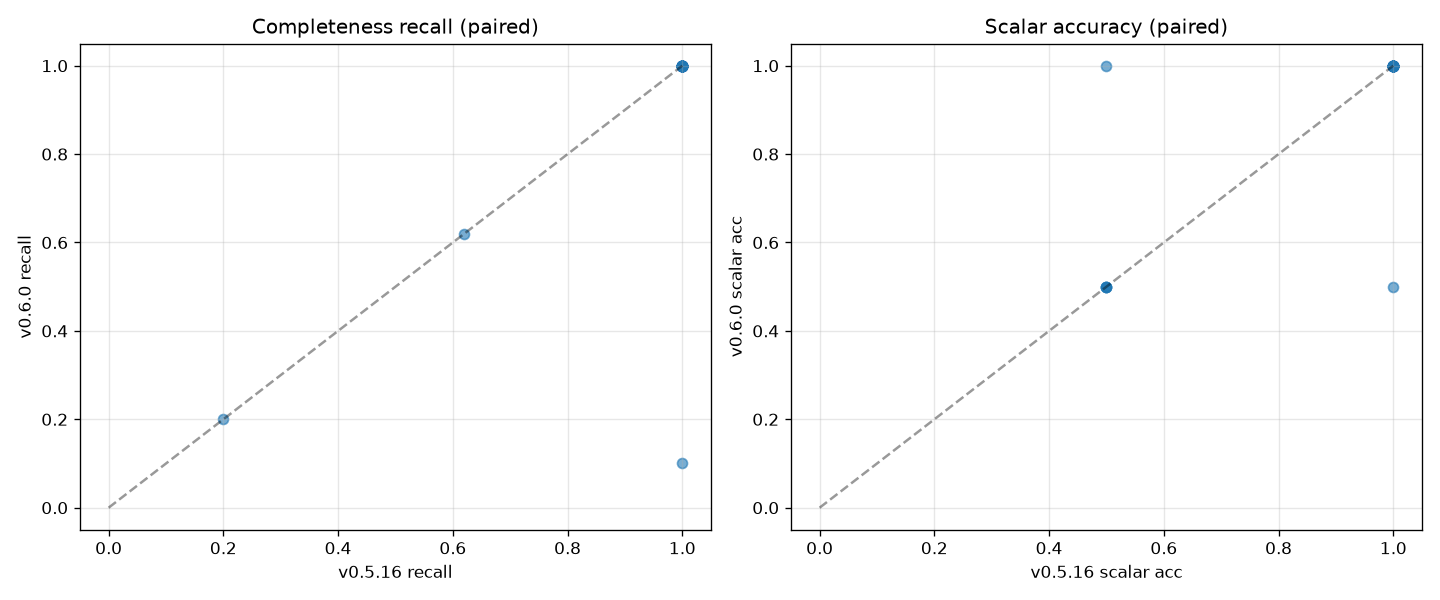
- Scalar accuracy: mean 0.917 on both versions; every (cell,doc) pair matches.
- Completeness recall: mean 0.961 → 0.931. The entire 0.030 drop is one cell
(
tt-simple-int, §4). Excluding it, recall is identical: 0.956 → 0.956. llm-simple-seprecall (0.607) is unchanged across versions — Nova LLM-OCR drops rows on the multi-pagesmall_narrow/tiny_formdocs equally on both versions (an OCR-backend property, not a version effect).
Confidence: mean confidence is comparable (0.935 → 0.910). v0.6 tends to report slightly lower/normalized confidence on advanced+BDA cells (e.g. bda-adv-sep 0.998 → 0.950), consistent with v0.6’s confidence-reporting changes; no calibration regression was flagged.
4. The one regression: simple + integrated confidence on long lists
Section titled “4. The one regression: simple + integrated confidence on long lists”core-tt-simple-int (textract+tables · simple extraction · integrated confidence)
is the only cell that got worse on v0.6:
| doc | recall 5.16→6.0 | scalar_acc 5.16→6.0 | cost 5.16→6.0 |
|---|---|---|---|
| longdesc_100 (100 rows, long descriptions) | 1.00 → 0.10 | 0.50 → 0.50 | $0.19 → $0.14 |
| small_narrow (100 rows) | 1.00 → 1.00 | 1.00 → 0.50 | $0.17 → $0.52 |
| tiny_form (5 rows) | 1.00 → 1.00 | 1.00 → 1.00 | $0.03 → $0.06 |
Root cause (verified from S3 output + metering on the v0.6 run): in integrated mode
v0.6 does extraction and confidence in a single Sonnet pass (metering shows
exactly one Extraction/bedrock call and no separate assessment call — the intended
single-pass behavior). On the long-description document that single pass truncated
the transaction list to 10 of 100 rows. v0.5.16’s integrated path recovered all 100
(it effectively ran a separate assessment pass). So v0.6 integrated mode is cheaper
per call but less robust on large/long-text lists.
Guidance: integrated confidence is a niche, cost-optimizing mode. For list-heavy
documents use separate confidence (default) or advanced mode — both are
complete and, on v0.6, also cheaper than they were on v0.5.16. This regression does
not affect the default separate or off assessment modes.
(One offsetting improvement: llm-simple-sep on longdesc_100 improved scalar
accuracy 0.50 → 1.00.)
5. Operational finding: v0.5.16 advanced-mode assessment doesn’t scale to large lists
Section titled “5. Operational finding: v0.5.16 advanced-mode assessment doesn’t scale to large lists”Independent of accuracy, v0.5.16 cannot reliably complete advanced (agentic) mode +
granular assessment on ≥400-row list documents: the assessment Lambda exceeds its
900 s timeout, and the state machine retries Sandbox.Timedout up to 8× at 2.5×
backoff (~2 h/doc) before failing. In a first full-core attempt (larger docs),
every advanced-mode cell hung on med_narrow/large_narrow/manylists_400, while
all simple-mode cells completed on the same docs. v0.6’s more parallel confidence
batching handles these without timing out. This is a real robustness improvement in
v0.6 and a reason to prefer it for large-list workloads.
(This benchmark holds the assessment batch size equal across versions — v0.6’s
extraction.confidence.list_batch_size=25 is mirrored into v0.5.16’s
assessment.granular.list_batch_size — so the timeout is a genuine engine difference,
not a config artifact.)
6. Reproduce
Section titled “6. Reproduce”source /home/ec2-user/projects/idp1/.venv/bin/activate # or any env with idp_common + reportlab/matplotlibexport PYTHONPATH=$PWD/lib/idp_common_pkgAWS_PROFILE=default aws sts get-caller-identity # confirm deployment account
# corpus + configs (v0.6-native, sonnet-4-6 control, v0.5.16-compat injection)python3 benchmarks/harness/gen_corpus.pypython3 benchmarks/harness/make_configs.py --suite corefast --class bank_statement
# run against a stack (native-upload REQUIRED so configs aren't migrated)AWS_PROFILE=default python3 benchmarks/harness/run_matrix.py \ --stack <STACK> --suite corefast --native-upload --max-inflight 6
# score + compareAWS_PROFILE=default python3 benchmarks/harness/aggregate.py --run benchmarks/results/run-<stamp> --out benchmarks/results/<rel>/corefastpython3 benchmarks/harness/aggregate.py --compare benchmarks/results/v0.6.0/corefast/summary.json --baseline benchmarks/results/v0.5.16/corefast/summary.jsonCaveats / honesty: costs are estimates from pricing.yaml (intro pricing may
apply). Grid is 3 docs/cell (n=3), so per-cell cost CV is high — the reliable signals
are the aggregate cost delta (−32.5% over 30 runs), the paired per-(cell,doc)
accuracy/recall (which are exact and stable), and the token-level explanation
(cacheRead −95%). Large-list advanced-mode cells are omitted from the head-to-head grid
because they cannot complete on v0.5.16 (§5) — that omission is the finding, not a
hidden failure.