

Release Benchmark: v0.6.5 vs v0.6.4
GenAIIDP Release Benchmark — v0.6.4 (published) vs v0.6.5
Section titled “GenAIIDP Release Benchmark — v0.6.4 (published) vs v0.6.5”Baseline: v0.6.4 — the previous publicly published release
(https://s3.us-west-2.amazonaws.com/aws-ml-blog-us-west-2/artifacts/genai-idp/idp-main_0.6.4.yaml,
Description (v0.6.4)).
Release under test: v0.6.5 (develop @ commit 720f3052a).
Method: a single stack (IDPBench065, us-west-2) was created
from the published v0.6.4 template, benchmarked, then upgraded in place to v0.6.5 via
idp-cli deploy --from-code . and benchmarked again with byte-for-byte identical config
files, written verbatim to the ConfigurationTable by compat/native_upload.py. The only
variable between the two runs is the accelerator code version.
Pricing: config_library/pricing.yaml (sha256 bc68d49e…; rates as of 2026-08; intro
pricing may apply).
Every number here is produced by
benchmarks/harness/aggregate.pyfrom live runs; none are recalled from memory. Supporting data:benchmarks/results/v0.6.4/corefast/andbenchmarks/results/v0.6.5/corefast/(summary.{json,csv},cell_stats.csv, and ametablock recording each side’s deployedstack_version).
Upgrading from the published v0.6.4 to v0.6.5 is safe: nothing regressed. It is not a completeness fix — read finding 2 carefully.
- Accuracy is identical. Mean scalar-field accuracy is 0.900 on both versions, and
every one of the 30 paired
(cell, doc)measurements matches exactly — the paired scatter in §3 sits entirely on the identity line. - Measured recall rose (0.931 → 0.987) but this is run-to-run variance, not a fix. Two
cells scored better and none scored worse; both improvements are single samples on
cells whose failure mode is non-deterministic. A follow-up repeated-measures run
(§3.1) settles it: on v0.6.5, the integrated-confidence cell that “recovered” is
bimodal — 2 of 4 repeats truncate the list to 10/100 rows and 2 of 4 return
100/100, on the same document, same config, same stack. The
integrated-confidence row-loss hazard is still present in v0.6.5; the
v0.6.0 report §4 guidance to avoid
integratedconfidence with simple extraction on list documents still stands. - Cost is flat where behaviour was stable: +1.4% across the 24 runs in the 8 cells whose recall did not move — inside their sampling spread. The headline total is +8.5%, but all of it sits in the two non-deterministic cells, where cost tracks whether that particular sample truncated the list. See §2.
- Review burden drops: the confidence alert rate (share of confidence leaves below 0.9) falls 10.7% → 6.4% with accuracy unchanged, so this is a reduction in review volume rather than over-confidence. Also n=30, so treat it as directional.
- No failures on either side: 30/30 documents completed on both versions.
aggregate.py --compare flags 0 cell-level regressions. It also flags 2 cell-level
“improvements”, which §3.1 shows are noise — a caution about the audit trail’s own
thresholds at n=3, not about the upgrade.
Methodology notes
Section titled “Methodology notes”Both sides are v0.6.x, so none of the cross-version config-compatibility handling the v0.6.0 A/B needed was exercised here. The scoping choices below are applied identically to both versions:
- Extraction model held at Claude Sonnet 4.6 (
default_cell.extraction_model: sonnet46). This is the committed cross-version control, kept here so this entry stays comparable with the rest of the audit trail. Both versions can run Sonnet 5; the cross-config study at the product default model is config-guidance, not this A/B. - Confidence model Nova Lite,
reasoning_effort=low,geometry=ocr_only. - Summarization disabled (
summarization.enabled=false) — it is unscored. corefastdoc set —tiny_form(5 rows, 1 page),small_narrow(100 rows, 3 pages),longdesc_100(100 rows, 3 pages, long free-text descriptions). The same three documents the audit trail has used since v0.6.0, so entries remain comparable.- Grid: all 10 core config cells × 3 docs = 30 runs per version.
- Configs written verbatim via
--native-upload, so the stored config bytes are identical on both sides rather than re-derived by a migration.
Test data
Section titled “Test data”Every document in this A/B is synthetic, fabricated data with exact machine-generated
ground truth — no real or externally-sourced documents were used. All three come from the
bank_statement generator (benchmarks/corpus/generators/bank_statement.py), regenerated
deterministically by gen_corpus.py, built from placeholder values (account
000123456789, fictional merchants like “AnyCompany Store”) with a unique SEQnnnnn tag
embedded in every transaction row. That makes list recall exact (distinct SEQ tags
recovered ÷ total) and scalar accuracy exact (field-exact match against the emitted
<doc>.truth.json), rather than measured against a human-curated baseline.
The wider corpus also holds a synthetic scaling series (25 → 3,200 rows) and a reference set of real labeled documents. Those are deliberately excluded from this head-to-head — the audit trail’s job is to isolate the code-version variable on a fixed, cheap, exactly-scored grid. Cross-config and scaling behaviour at v0.6.5 is the subject of config-guidance.
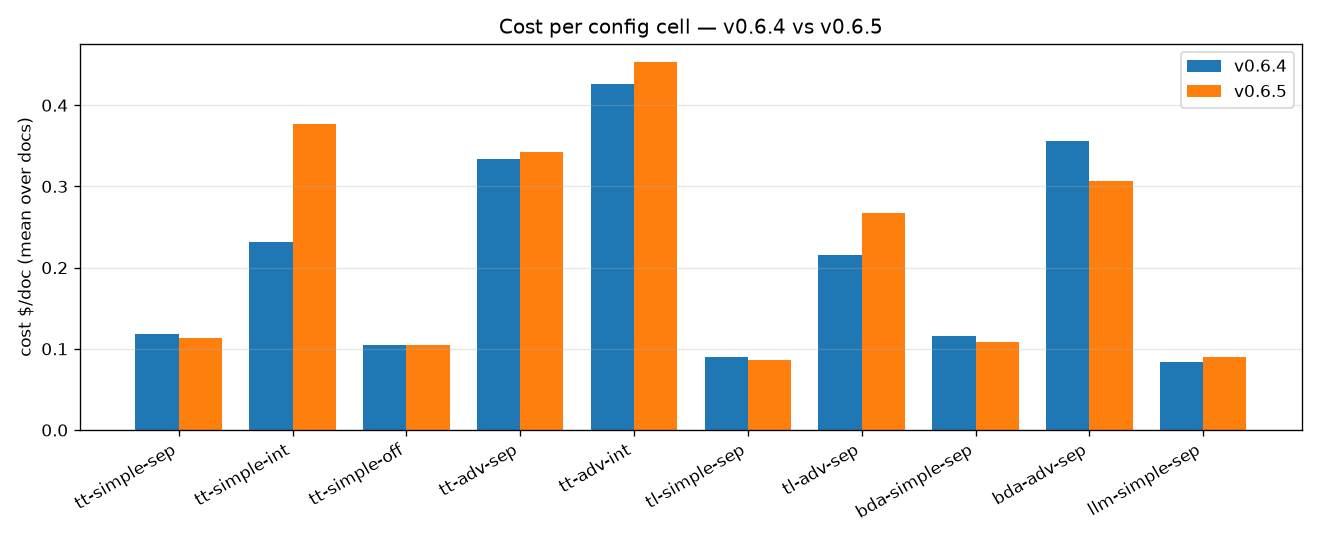
1. Per-cell summary (mean over the 3 corefast docs)
Section titled “1. Per-cell summary (mean over the 3 corefast docs)”| cell (OCR · mode · assess) | $/doc v0.6.4 | $/doc v0.6.5 | Δcost | cost CV (6.4/6.5) | recall v0.6.4 | recall v0.6.5 | wall v0.6.4 | wall v0.6.5 |
|---|---|---|---|---|---|---|---|---|
| tt-simple-sep (textract+tables · simple · separate) | $0.118 | $0.113 | −4% | 0.62/0.61 | 1.000 | 1.000 | 161s | 109s |
| tt-simple-int (textract+tables · simple · integrated) | $0.231 | $0.377 | +63% | 0.99/0.71 | 0.700 | 1.000 | 146s | 170s |
| tt-simple-off (textract+tables · simple · off) | $0.105 | $0.105 | −0% | 0.64/0.64 | 1.000 | 1.000 | 35s | 34s |
| tt-adv-sep (textract+tables · advanced · separate) | $0.334 | $0.343 | +3% | 0.71/0.70 | 1.000 | 1.000 | 90s | 152s |
| tt-adv-int (textract+tables · advanced · integrated) | $0.426 | $0.453 | +6% | 0.72/0.76 | 1.000 | 1.000 | 107s | 116s |
| tl-simple-sep (textract+layout · simple · separate) | $0.090 | $0.087 | −3% | 0.72/0.71 | 1.000 | 1.000 | 84s | 55s |
| tl-adv-sep (textract+layout · advanced · separate) | $0.215 | $0.268 | +24% | 0.68/0.77 | 1.000 | 1.000 | 88s | 154s |
| bda-simple-sep (BDA · simple · separate) | $0.116 | $0.109 | −6% | 0.66/0.64 | 1.000 | 1.000 | 112s | 52s |
| bda-adv-sep (BDA · advanced · separate) | $0.356 | $0.306 | −14% | 0.97/0.74 | 1.000 | 1.000 | 113s | 118s |
| llm-simple-sep (Bedrock Nova OCR · simple · separate) | $0.084 | $0.090 | +7% | 0.75/0.75 | 0.607 | 0.873 | 49s | 96s |
scalar_accuracy is not shown per-cell because it is identical across versions for every
cell (§3).
Read the cost column with the CV column. Every cell’s per-doc cost CV is 0.6–0.99 at
n=3 — the three corefast documents differ hugely in size, which is the point of the doc set
but makes a single cell’s cost mean a noisy statistic. The variance-aware cell-level pass
of aggregate.py --compare therefore reports tt-simple-int (+63%) and
tl-adv-sep (+24%) as inconclusive at this n, and flags no cell-level cost
regression. The trustworthy cost reading is the aggregate decomposition in §2.
2. Cost — flat where nothing changed, higher only where rows were recovered
Section titled “2. Cost — flat where nothing changed, higher only where rows were recovered”| scope | v0.6.4 | v0.6.5 | Δ |
|---|---|---|---|
| All 30 runs | $6.223 | $6.750 | +8.5% |
| The 24 runs in the 8 cells whose recall did not change | $5.279 | $5.350 | +1.4% |
| The 6 runs in the 2 non-deterministic cells (§3.1) | $0.945 | $1.399 | +48.2% |
So the headline +8.5% is not a general cost regression: 8 of 10 cells move +1.4% in aggregate, inside their sampling spread, and the entire increase is concentrated in the two non-deterministic cells, where the sample that extracted more rows cost more:
| cell · doc | rows extracted / truth | cost |
|---|---|---|
| tt-simple-int · longdesc_100 | 10/100 → 100/100 | $0.135 → $0.536 |
| tt-simple-int · small_narrow | 100/100 → 100/100 | $0.493 → $0.528 |
| tt-simple-int · tiny_form | 5/5 → 5/5 | $0.066 → $0.067 |
| llm-simple-sep · tiny_form | 1/5 → 5/5 | $0.0138 → $0.0139 |
In the v0.6.5 sample tt-simple-int on longdesc_100 extracted 10× the rows for ~4× the
cost. §3.1 shows both outcomes occur on v0.6.5 at roughly even odds, so read this row as
“the cost of a complete extraction vs a truncated one on the same document” rather than as a
version delta. The other two tt-simple-int documents, which were complete on both sides,
moved +7% and +0.2%.
Token totals across the grid (from per-doc Metering):
| unit | v0.6.4 | v0.6.5 | Δ |
|---|---|---|---|
| input | 609,452 | 907,379 | +49% |
| output | 361,845 | 382,057 | +6% |
| cacheRead | 1,266,547 | 1,331,948 | +5% |
| cacheWrite | 173,695 | 220,908 | +27% |
The input-token rise is the mechanism behind the cost delta and has two identified
contributors, both intended v0.6.5 behaviour: the confidence pass now attaches page
images whenever the prompt asks for them (previously suppressed whenever
geometry.mode was ocr_only — the default — which is the fix documented in the 0.6.5
CHANGELOG, at a stated ~1.7K additional input tokens per page), and the integrated cell is
now processing ten times as many rows. Output tokens rose only 6%, consistent with the work
being input-side.
⚠️ Cost note for operators: the page-image attachment applies to any config that keeps
{DOCUMENT_IMAGE} in extraction.confidence.task_prompt (the shipped default). On
image-heavy or high-page-count corpora this is a real per-page cost increase. Removing the
placeholder from that prompt opts back into a text-only confidence pass.
3. Accuracy & completeness
Section titled “3. Accuracy & completeness”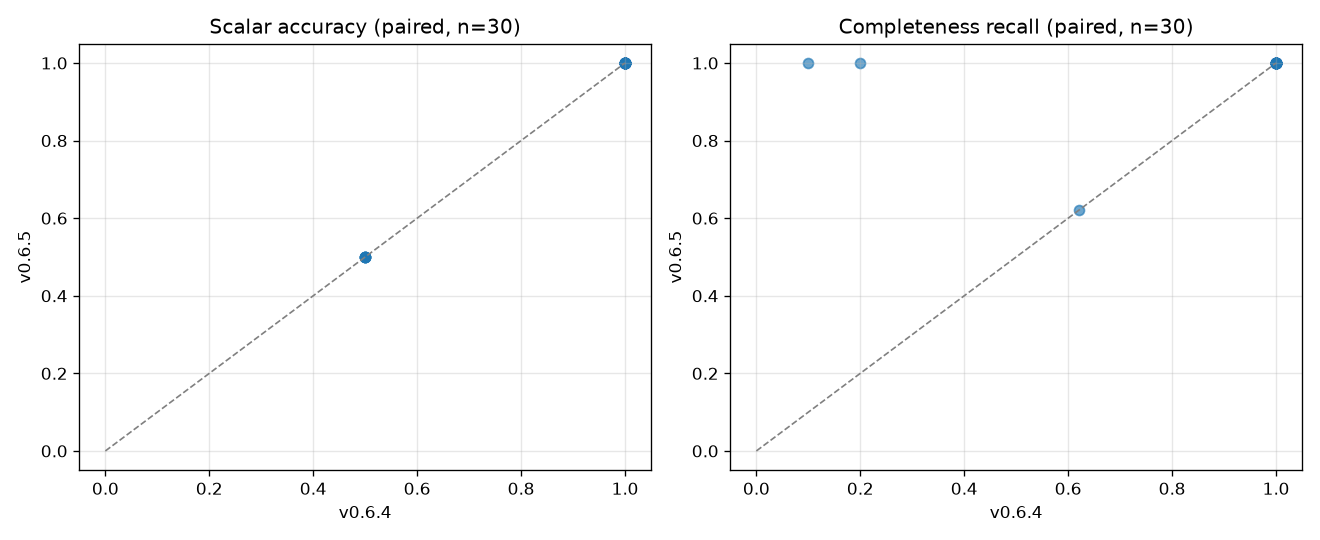
- Scalar accuracy: mean 0.900 on both versions; all 30 paired
(cell, doc)measurements are equal, which is why the left panel is a single line of points on the diagonal. - Completeness recall: mean 0.931 → 0.987. In the right panel every off-diagonal
point is above the line: two apparent improvements, zero regressions. Both are
single samples on non-deterministic cells (§3.1) — the safe reading is “no regression”,
not “+0.057”.
tt-simple-int0.700 → 1.000 (driven bylongdesc_100: 0.10 → 1.00) — shown to be noise in §3.1llm-simple-sep0.607 → 0.873 (driven bytiny_form: 0.20 → 1.00) — not independently re-measured; treat as unconfirmed
- Confidence: mean confidence flat (0.9287 → 0.9293), while the alert rate (share of confidence leaves below 0.9) falls 10.7% → 6.4%. Because accuracy is unchanged, fewer alerts means less review for the same correctness, not a model that has become over-confident.
- Failures: 0 on both versions (30/30 completed each).
3.1 The integrated-confidence “improvement” is noise — the hazard is still open
Section titled “3.1 The integrated-confidence “improvement” is noise — the hazard is still open”The v0.6.0 report §4 recorded a regression where simple extraction + integrated confidence truncated a long-description 100-row list to 10 rows, and recommended avoiding that combination. The grid above finds the v0.6.4 stack still doing it (10/100 rows) and the v0.6.5 stack returning all 100 — which reads like a fix.
It is not. The grid measures each (cell, doc) once, and the failure mode is a partial
list, not an error, so a single sample cannot separate “fixed” from “got lucky”. Re-running
that exact cell 4× on v0.6.5 with a separate-confidence control on the same document
(--suite intconf, extraction model held at the same Sonnet 4.6 control) gives:
| cell | repeat | rows extracted / truth | recall | cost | wall |
|---|---|---|---|---|---|
| tt-simple-int | 0 | 10/100 | 0.100 | $0.139 | 62s |
| tt-simple-int | 1 | 10/100 | 0.100 | $0.139 | 59s |
| tt-simple-int | 2 | 100/100 | 1.000 | $0.536 | 188s |
| tt-simple-int | 3 | 100/100 | 1.000 | $0.532 | 186s |
| tt-simple-sep | 0–3 | 100/100 ×4 | 1.000 | ~$0.159 | ~76s |
The integrated cell is bimodal on v0.6.5 — 2 of 4 repeats truncate to exactly 10 rows —
while the separate control is complete 4 of 4 at a third of the cost. The v0.6.4 → v0.6.5
“recovery” in §1/§3 was therefore a coin flip that landed differently on each side, and it
is a live demonstration that this audit trail’s n=3, 1-repeat grid cannot resolve a
non-deterministic completeness failure. Two further consequences worth stating:
scalar_accuracyis 0.50 in all eight runs above, identical whether 10 or 100 rows came back. The scalar fields are correct either way, so a truncated document scores the same as a complete one on that metric — the row loss is only visible in list recall.- The wider v0.6.5 cross-config grid (7 synthetic docs, product-default Sonnet 5) finds the same hazard much worse at scale: mean recall 0.294, and on an 800-row document the transaction list is absent from the response entirely. See config-guidance §2.
Guidance unchanged and reinforced: use separate confidence (the default) on
list-heavy documents. Do not use integrated with simple extraction.
Data: the intconf run on Sonnet 4.6 — pruned per
RETENTION.md
(one complete set per release); restore with git checkout ec3eb05ae -- benchmarks/results/v0.6.5-intconf-sonnet46/. Reproduce:
python3 benchmarks/harness/make_configs.py --suite intconf --class bank_statement --set extraction_model=sonnet46AWS_PROFILE=default python3 benchmarks/harness/run_matrix.py --stack <STACK> --suite intconf --native-upload4. What --compare flagged, and why none of it is a regression
Section titled “4. What --compare flagged, and why none of it is a regression”REGRESSIONS (4) all cost-only, no accuracy/recall/failure regressions tt-simple-int|longdesc_100 cost +298% ← this sample returned 100 rows, not 10 (§3.1) tl-adv-sep|longdesc_100 cost +48% ← within cell sampling spread (CV 0.68/0.77) bda-adv-sep|tiny_form cost +49% ← $0.039→$0.058 on the 5-row doc; absolute Δ $0.019 bda-adv-sep|small_narrow cost +18% ← within cell sampling spread; cell mean is −14%IMPROVEMENTS (2) both single-sample; §3.1 shows the first is noise tt-simple-int|longdesc_100 completeness_recall +0.900 llm-simple-sep|tiny_form completeness_recall +0.800CELL-LEVEL REGRESSIONS (0)CELL-LEVEL IMPROVEMENTS (2) ← not real; see §3.1 tt-simple-int recall 0.700→1.000 llm-simple-sep recall 0.607→0.873The four per-run cost flags are the row-level threshold (+15%) firing on single samples;
the variance-aware cell-level pass — the one designed to separate a real cost shift from
agentic/size noise — reports none of them as regressions, and bda-adv-sep’s cell mean
actually fell 14%.
A gap this release exposed in the comparison tool. aggregate.py --compare applies its
variance-aware treatment to cost but not to completeness/accuracy, so a
non-deterministic recall swing is promoted to a headline “CELL-LEVEL IMPROVEMENT” from a
single sample — exactly what happened here, in the direction that flatters the release.
Recall/accuracy deltas should get the same spread-aware gate as cost, or the grid needs
repeats > 1 on the cells with known non-deterministic failure modes.
5. Reproduce
Section titled “5. Reproduce”source /home/ec2-user/projects/idp1/.venv/bin/activate # or any env with idp_common + reportlab/matplotlibexport PYTHONPATH=$PWD/lib/idp_common_pkgAWS_PROFILE=default aws sts get-caller-identity # confirm deployment account
# 1. deploy the PREV published release, benchmark itidp-cli deploy --stack-name <STACK> --admin-email <you> --region us-west-2 --wait \ --template-url https://s3.us-west-2.amazonaws.com/aws-ml-blog-us-west-2/artifacts/genai-idp/idp-main_0.6.4.yamlpython3 benchmarks/harness/gen_corpus.pypython3 benchmarks/harness/make_configs.py --suite corefast --class bank_statementAWS_PROFILE=default python3 benchmarks/harness/run_matrix.py --stack <STACK> --suite corefast --native-upload --max-inflight 6AWS_PROFILE=default python3 benchmarks/harness/aggregate.py --run benchmarks/results/run-<stamp> --out benchmarks/results/v0.6.4/corefast
# 2. upgrade the SAME stack in place, re-run the identical grididp-cli deploy --stack-name <STACK> --from-code . --region us-west-2 --waitAWS_PROFILE=default python3 benchmarks/harness/run_matrix.py --stack <STACK> --suite corefast --native-upload --max-inflight 6AWS_PROFILE=default python3 benchmarks/harness/aggregate.py --run benchmarks/results/run-<stamp2> --out benchmarks/results/v0.6.5/corefast
# 3. compare + chartspython3 benchmarks/harness/aggregate.py --compare benchmarks/results/v0.6.5/corefast/summary.json --baseline benchmarks/results/v0.6.4/corefast/summary.jsonpython3 benchmarks/harness/aggregate.py --figures-compare benchmarks/results/v0.6.5/corefast/summary.json benchmarks/results/v0.6.4/corefast/summary.json --labels v0.6.5 v0.6.4Caveats / honesty
- Costs are estimates from
pricing.yaml(rates as of 2026-08; intro pricing may apply). - n = 3 docs per cell, 1 repeat, and the three documents differ greatly in size, so per-cell cost CV is 0.6–0.99. Per-cell cost deltas in §1 are therefore not individually significant; the reliable signals are the aggregate cost decomposition (§2), the paired per-(cell,doc) accuracy/recall (exact and stable), and the token totals that explain the cost movement.
- The two recall “improvements” in §1/§3 rest on one measurement per document. The
intconfrepeated-measures run (§3.1) shows the integrated-confidence one is noise; thellm-simple-sepone was not re-measured and should be treated as unconfirmed. The claim this entry stands behind is “no regression”, not “+0.057 recall”. - Only the
corefastgrid was run for this A/B. The scaling series and the reference (real, labeled) corpora were not run against v0.6.4, so this entry makes no claim about release-over-release behaviour on documents larger than 100 rows or on real-world corpora.