How it works
GCO is one CDK application that deploys a global control plane plus one regional stack per target region, all in a single AWS partition. This page is the high-level story; the authoritative deep dive is docs/ARCHITECTURE.md, with the conceptual model in docs/CONCEPTS.md.
The multi-region platform
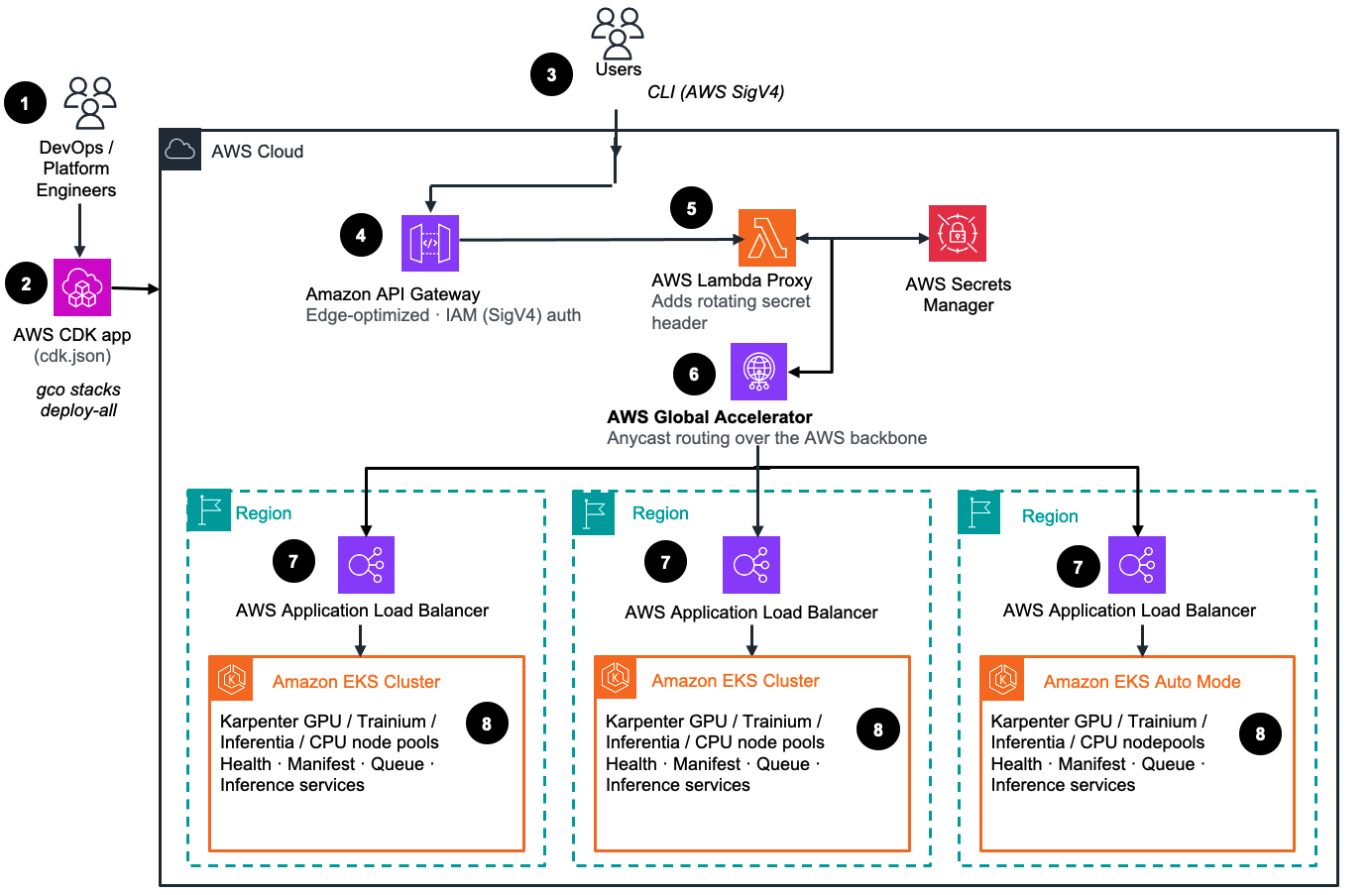
Part 1 — the multi-region reference architecture: global control plane and workload entry.
Platform engineers configure everything in cdk.json and drive deployment
from the gco CLI. The global side provides partition-wide state (SSM
parameters, DynamoDB tables, an S3 model bucket) and — in commercial aws
only — a Global Accelerator that gives workload traffic a single anycast
entry point with health-based cross-region routing and automatic failover.
API Gateway enforces IAM (SigV4) authentication on every exposed method, and
Lambda proxies wrap workload requests in a short-lived HMAC envelope before
they travel to a region. Other partitions (aws-cn, aws-us-gov) skip the
accelerator and route through IAM-authenticated regional APIs instead.
Inside a region
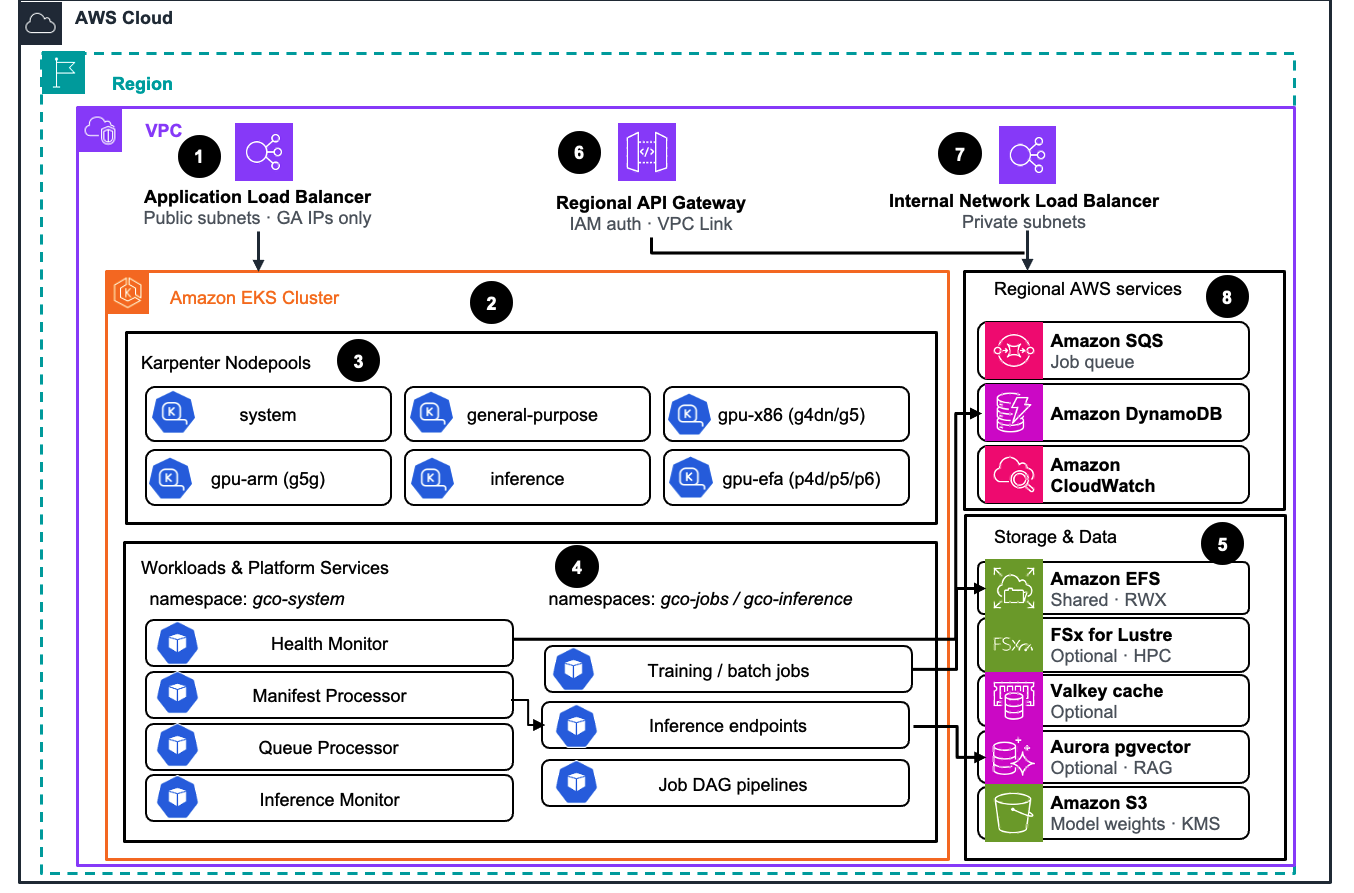
Part 2 — the regional EKS Auto Mode data plane and platform services.
Each regional stack is a VPC with an EKS Auto Mode cluster (private API
endpoint by default), an internal ALB provisioned from shared Gateway API
resources, Amazon EFS for persistent job outputs, and optional FSx for
Lustre. Capacity comes from NodePools provisioned on demand: the built-in
system and general-purpose pools plus project-managed GPU x86, GPU ARM,
inference, EFA, Mooncake EFA, Neuron, and CPU pools.
Platform services run in the gco-system namespace — a health monitor,
manifest processor, queue processor, inference monitor, and inference proxy —
while user workloads land in gco-jobs and gco-inference. Scheduler and
operator Helm charts (KEDA, Volcano, KubeRay, cert-manager, Kueue, and
opt-ins) are installed asynchronously by a Step Functions state machine with
per-chart retry, so a slow chart never rolls back the cluster.
How a job flows
Manifests arrive by one of four submission paths — an SQS queue (recommended for production), the IAM-authenticated REST API, a centralized DynamoDB job queue with priority and audit trail, or direct kubectl. On the SQS path, a KEDA-scaled queue processor consumes messages (zero pods when the queue is empty), and the manifest processor validates each manifest against the security policy before applying it. EKS Auto Mode then provisions a matching node, the job runs, and outputs can persist to EFS or FSx after the pod terminates. The step-by-step walk-through lives in Core Concepts — How Components Work Together.
Capacity decisions stay explicit: gco capacity exposes spot placement
scores, spot price history, capacity reservations, and Capacity Blocks, and
auto-region workflows use those signals to pick a target region. Routing is
transparent; placement is deliberate.
The security posture
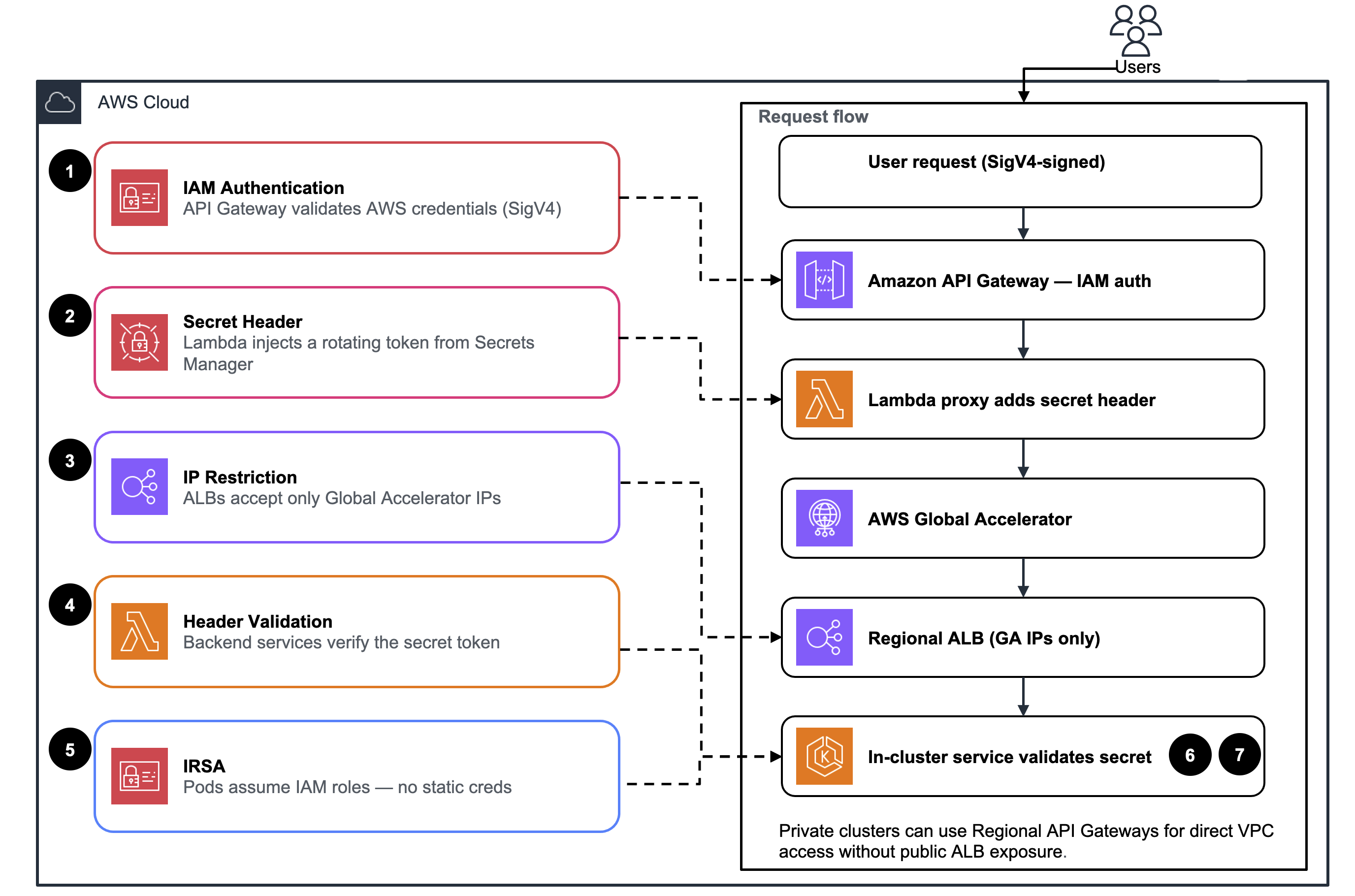
Part 3 — security controls and the authenticated request flow.
Six complementary controls protect every backend request: IAM authentication at API Gateway, TLS trust separation (AWS-managed TLS at the edge, a deployment-local private root behind it), a request-bound rotating HMAC, private backend exposure (internal ALBs, private EKS endpoints), freshness/integrity validation in backend middleware, and IRSA / EKS Pod Identity for pod-level AWS access without static credentials. The README's Security Model section shows the exact request flow per partition.
Keep reading
- docs/ARCHITECTURE.md — layers, data flows, and scale characteristics
- docs/CONCEPTS.md — the mental model behind the components
- README — Architecture Overview — the generated CDK diagram and per-stack workflows