Global Capacity Orchestrator on AWS
One API. Every Accelerator. Any Region.
Global Capacity Orchestrator (GCO) is multi-region accelerated-compute orchestration for AWS — NVIDIA GPUs, AWS Trainium, AWS Inferentia, and CPU (amd64 + arm64/Graviton) — with capacity-aware placement workflows, spot fallback, and autoscaling inference endpoints. You submit a Kubernetes manifest; GCO validates it, provisions matching nodes through EKS Auto Mode, runs it, and can persist outputs to shared storage after pods terminate.
This wiki is an orientation layer: each page summarizes one facet of the project and routes you to the authoritative documentation on GitHub. The deep reference material lives in the repository — start with the README and the documentation index.
Is GCO for you?
GCO is built for teams running accelerated workloads — LLM training and inference, batch ML, HPC, and general CPU jobs — that need multi-region redundancy, capacity discovery, and IAM-based access without per-cluster kubeconfig distribution. It fits when:
- You run GPU workloads (training, inference, batch processing) and want capacity-aware region selection instead of manually checking each region.
- You want inference endpoints deployed across multiple regions with a single
command, with automatic failover in the commercial
awspartition. - You prefer IAM (SigV4) authentication over kubeconfig management.
- You need job outputs to persist after pods terminate (EFS/FSx).
The full problem/solution comparison lives in the README's Why GCO? section, and Core Concepts explains the ideas behind it.
What you get
- One coherent API across regions: a global, IAM-authenticated workload
API with health-based failover in commercial
aws; IAM-authenticated regional workload APIs inaws-cnandaws-us-gov— all through the same CLI and MCP server. - Capacity intelligence: spot placement scores, spot price history,
capacity reservations, and auto-region workflows behind
gco capacity— network routing never substitutes for live GPU-capacity placement.
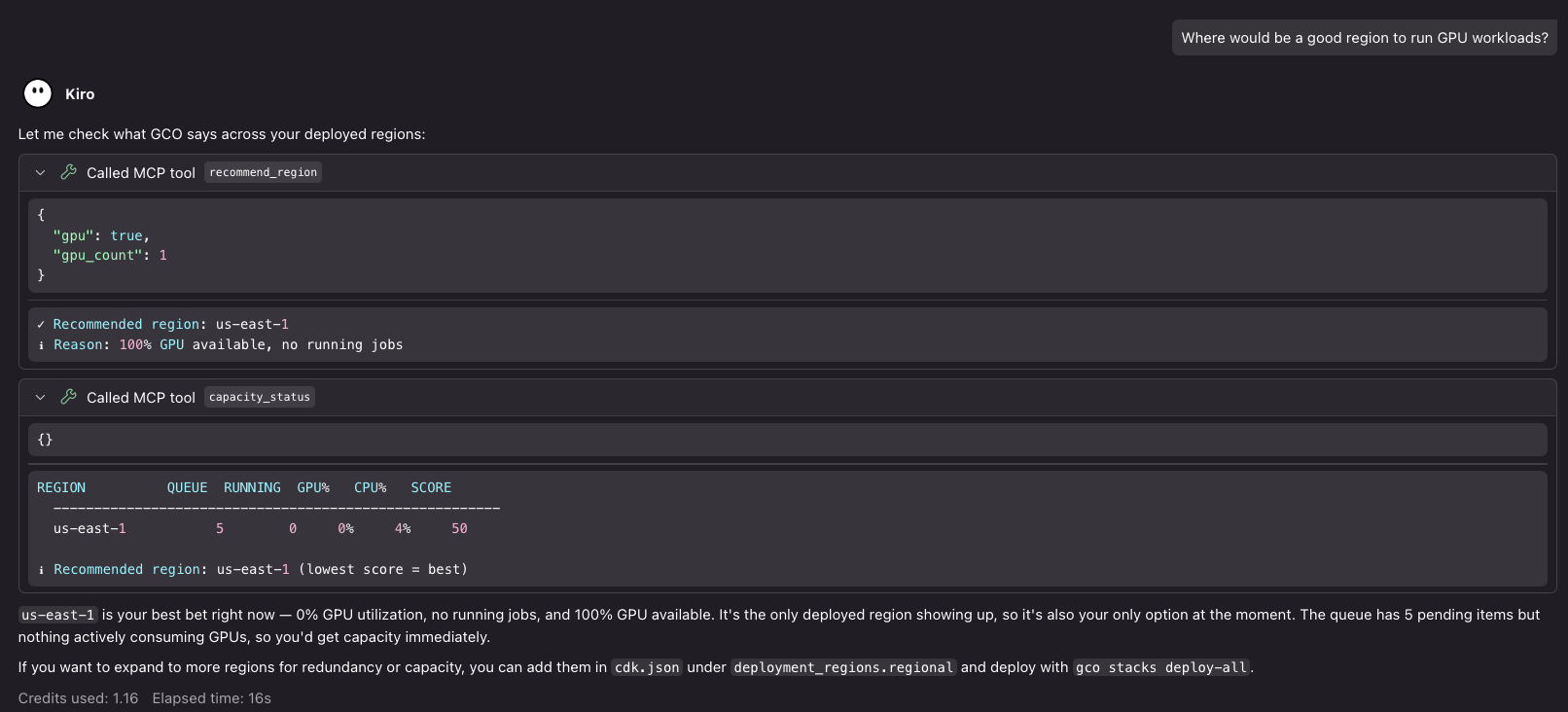
Capacity discovery the conversational way: the GCO MCP server answering a GPU capacity question in an AI-powered IDE.
- Automatic GPU node provisioning through EKS Auto Mode and purpose-built NodePools (GPU x86/ARM, inference, EFA, Neuron, CPU).
- Multi-region inference endpoint management (vLLM, TGI, Triton, TorchServe, SGLang) with rolling updates, scaling, and canary deployments.
- An agent-first front door:
gco autopilotlaunches Claude Code by default, whilegco autopilot --engine codexlaunches OpenAI Codex. Both run on Amazon Bedrock, grounded by the project's own MCP server and recommended companion MCPs—see docs/AUTOPILOT.md.
Guided by ordered tenets
Every trade-off in GCO is resolved against ten prioritized project tenets, beginning with Protect Workloads, Data, and Accounts and Tell the Truth About State and Capacity. Earlier tenets outrank later ones, and durable exceptions require an Architecture Decision Record.
What it costs
The README's sample cost table estimates a single-region deployment at roughly $210/month of fixed platform cost (EKS cluster, NAT gateways, ALB, monitoring, and friends) — GPU instances dominate real spend and scale with usage. Multi-region deployments scale linearly.
Where to go next
| You are… | Start with |
|---|---|
| Evaluating GCO or deploying it for the first time | Evaluating & deploying |
| Wondering what workloads it supports | What you can run |
| Trying to understand the architecture | How it works |
| A developer exploring the codebase | Repo tour and How we build & test |
| Ready to contribute or fork | Contributing |
New to Kubernetes itself? The repository ships a staged Learning Path with a primer and role-based tracks.