Evaluating & deploying
The Quick Start Guide is the authoritative walkthrough — it aims to take you from a clean machine to a running deployment in under 60 minutes, and it marks the exact point where AWS charges begin. This page summarizes the journey so you know what you are signing up for.
What you need
- Recommended path: a container runtime (Docker, Finch, or Colima) and AWS credentials. The dev container ships everything else — Python, Node.js, CDK, kubectl, and the AWS CLI at pinned versions — so you skip dependency resolution entirely.
- Host installs are the advanced path. GCO pins exact versions of many Python packages; the README's Prerequisites section covers the clean-virtualenv route and its known caveats.
The journey
- Clone and build the dev container — a setup script builds the image
and wires a
gcoshell function so commands run from your normal shell. - First success milestone — the CLI runs locally; no AWS charges yet.
- Deploy — one command stands up the global control plane and every
region configured in
cdk.json. CDK bootstrap happens automatically. This is the point where billable AWS resources exist. Helm charts converge asynchronously afterwards and can take 10–30+ minutes. - Submit a test job and (optionally) an inference endpoint — the repository ships ready-to-submit example manifests.
- Tear down — one command destroys the stacks with best-effort cleanup of known resources.
Prefer to let an agent drive? gco autopilot launches Claude Code by
default; gco autopilot --engine codex launches OpenAI Codex. Both run on
Amazon Bedrock with the GCO MCP server and recommended companions wired in—so
you can deploy, check capacity, and submit jobs conversationally. See
docs/AUTOPILOT.md.
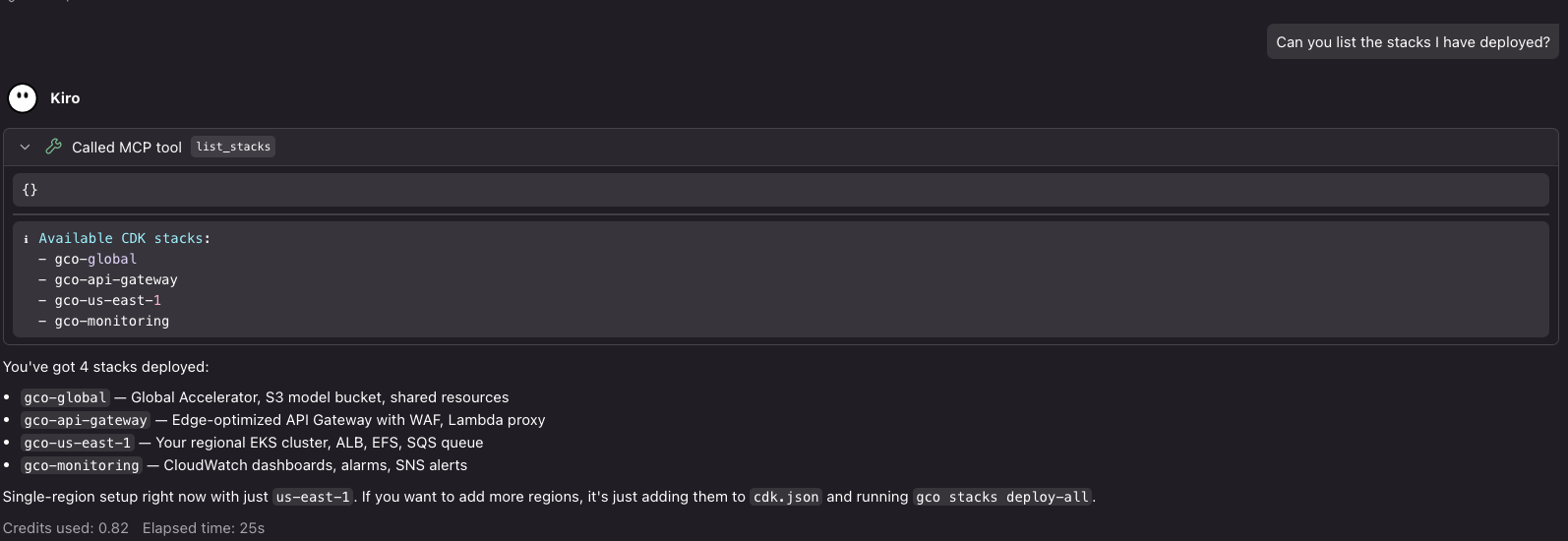
What a deployed platform looks like from an agent session: listing the CDK stacks via the GCO MCP server.
What it costs
The README's sample cost table breaks down a single-region deployment with default settings: a fixed platform cost dominated by the EKS cluster, NAT gateways, the internal ALB, Global Accelerator and CloudWatch, with GPU instances the real driver of spend — an on-demand instance runs around three times the spot price of the same type. Optional services (FSx, Valkey, Aurora, the analytics environment) add cost only when enabled, and multi-region deployments scale linearly. The table carries its own pricing date; read the numbers there rather than here.
What you can customize
Deployment configuration is a single file: cdk.json defines the regions,
features, and thresholds. The
Customization Guide
is the reference for all of it — deployment regions (any SDK-known region in
one partition, no count limit), endpoint access modes, GPU NodePool instance
types and spot preferences, security policy toggles, Helm chart
configuration, and the optional storage and data services. Most optional
features follow the same pattern: off by default, enabled with one toggle,
zero cost until enabled.
Where to go next
- QUICKSTART.md — the full step-by-step walkthrough
- docs/CUSTOMIZATION.md — every knob, from regions to NodePools to feature toggles
- docs/CLI.md — the complete command reference
- What you can run — the workload catalog this platform serves